
The Problem
A customer in Detroit clicks a lease ad built specifically for their market, offering terms available at their local dealers. They land on the national site, where those offers don’t exist. The ad promised something the destination couldn’t deliver.
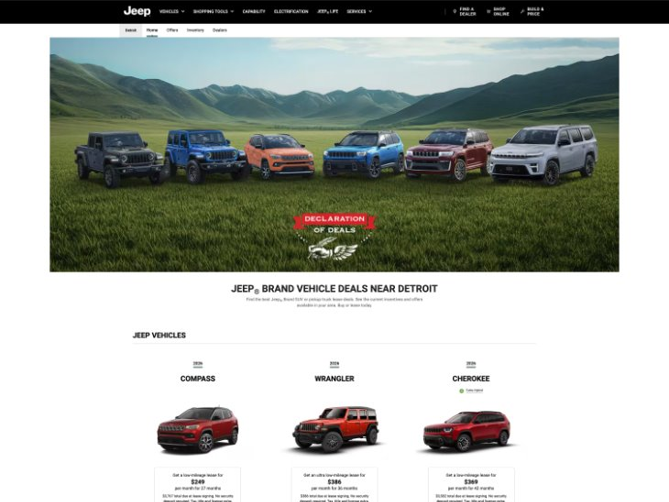
Fixing that meant building a self-contained local shopping experience: a customer arriving from a market-specific ad lands on market-specific offers, with a path straight into local inventory. It came in as a last-minute special project on an already compressed timeline.
Role: Associate Director, Experience Design.
Team: 1 junior designer, PM, PO, lead tech, 5 engineers, QA
Client: Stellantis – Jeep. To be expanded to Ram, Dodge, Chrysler, Fiat and Alfa Romeo
Timeline: Spring 2026
Approach
I was lead UX from the initial briefing. To protect the schedule, I did the hands-on design myself in a single day and presented high-fidelity wireframes to the client the following morning, ahead of schedule, taking roughly a week out of the plan. The client called out the speed at which we reached the final design.
From there, the junior designer on my team took those wireframes into full comps under my guidance, working from our shared design system. That handoff only worked because we keep close contact with the library team, so the components we build against reflect the latest states rather than a stale copy.
Speed came from coordination, not from working alone. Through the sprint, I ran constant checks with the PO, PM and developers to confirm that what we were designing was feasible and still on track. On a compressed timeline, the expensive failure isn’t a slow design, but one that turns out to be unbuildable in week two.
Solution
The experience reuses four existing platform templates rather than inventing new page types: Search New Inventory, Offers and Incentives, Find a Dealer, and Vehicle Line Up. Those four already covered everything a local shopper needed.
Recomposing them into a market-scoped flow traded some visual freedom for a build engineering could execute inside one sprint, and made the pattern repeatable by construction rather than by intention.
Outcome
Piloted on Jeep.com/local/detroit, scoped as phase one of a pattern extensible to roughly 210 designated market areas and set to expand across all brands.
What this project shows is a different thing from a long redesign: judgment under compression. Knowing which constraint actually matters, and building the conditions that let a small team move fast without breaking what comes after.
On a compressed timeline, the expensive failure isn’t a slow design, but one that turns out to be unbuildable in week two.